
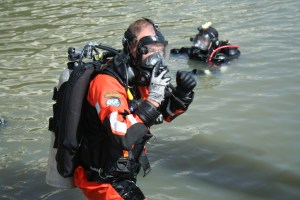
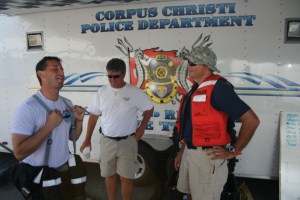
The Corpus Christi Police Dive Team completed 40 hours of professional water rescue training last week with newly acquired equipment which was used to recover a vehicle that went into the Corpus Christi Marina Sunday night.
The Corpus Christi Police Dive Team received grant money to obtain equipment for light vehicle recovery and to have a trainer provide instruction for the proper and safe use of the equipment. Steve Salach is a corporate trainer for Dive Rescue International and came to Corpus Christi from Fort Lauderdale, Florida for the week to train the Corpus Christi Police Dive Team.
Salach said the dive teams throughout the nation are not classified by the skill level of the divers, but rather they are classified by the equipment they possess. Salach said the individual diver can have a broad variety of skills and capabilities, but the equipment is what makes the diver useful for emergency operations like the Corpus Christi Police Dive Team. Salach is primarily employed by the Broward County Sheriff’s Office as a Chief Diver and Trainer and began the week of training with individual diver safety.
The Corpus Christi Police Dive team began the 40 hour training session on July 16 at Labonte Park with a three-day class called Public Safety Diver Survival. The divers in Corpus Christi have a variety of individual hazards to negotiate. One hazard is that the waters in this area are murky and have no visibility. The divers operate in water in which they cannot see their hand extended in front of them and light disappears four feet below the surface. Salach said this low visibility condition is common throughout the country and presents a first safety concern for manipulating submerged equipment.
A second hazard divers must overcome is the contaminated waters. Salach said the fluids from vehicles, pollution, and waterborne bacteria create an unsanitary and hazardous condition for divers. Salach said that years ago, divers wore shorts, a t-shirt, a small mask and a breathing hose; but, that has changed over the years because of water contamination. Divers now wear a full mask and a dry suit to protect themselves from pollutants and bacteria.
Other hazards in the water include the wildlife. Alligators, snakes, and other animals in the water can provide a significant hazard to divers especially in reduced visibility conditions.
Another hazard for divers is the heat. Salach said there is no emergency activity that taxes the body more than rescue diving. The divers must be in excellent physical condition to operate in the water. The water is hot and the work is like rigorous exercise, and the dry suit worn by the divers is a plastic bag over their body.
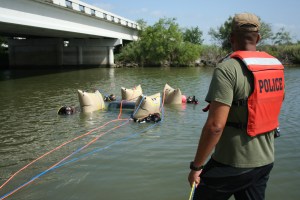
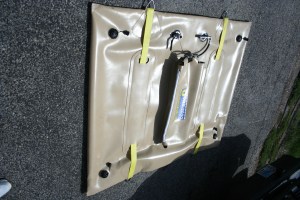
The final days of training were with the new light salvage and recovery system. The lifting system is basically bags that are connected to a submerged vehicle and then filled with air to make the vehicle buoyant. The vehicle can then be moved closer to shore or to a more advantageous location to extract the vehicle from the water with the use of a tow truck or crane.
The system was used to recover a vehicle that went into the Corpus Christi Marina Sunday night as a result of reckless driving. No person was injured in the vehicle crash when it entered the water. The Corpus Christi Police Dive Team recovered the vehicle Monday morning. The Corpus Christi Police Dive Team also recovered a vehicle from Packery Channel on July 4.
The next piece of equipment the Corpus Christi Police Dive Team will acquire is also through grant money. The Dive Team will obtain a remote operated vehicle next month. Team members will travel to San Diego California to gain the training for the new tool and bring back a new R.O.V. to belong to the Corpus Christi Police Department.
Salach said the one main obstacle for any dive team is funding. Dive teams are often neglected until they are needed. The Corpus Christi Police Dive Team have acquired much of their equipment and training from grants from which dive team members have applied.
 CCPD Blotter
You must be logged in to post a comment.