Contributed by the Coastal Bend – South Texas Chapter of the Red Cross:
A Corpus Christi firefighter, police lieutenant and assistant chief for the Nueces County Sheriff’s office have been selected to receive Hometown Heroes awards at the Red Cross Heroes Breakfast Tuesday, August 14, 2012 at 8 a.m. at the Solomon P. Ortiz Center. Eddie Yaklin, who received national attention in 2009 for rescuing three fisherman who were stranded 185 miles offshore for eight days will be the featured speaker.
Corpus Christi fireman John Keller, Corpus Christi Police Lieutenant Brian Hill and Nueces County Sheriff’s Office Assistant Chief Peter Peralta were chosen as hometown heroes for their actions in overcoming seemingly overwhelming obstacles to serve their community and to save and preserve lives.
On March 30, 2012, Firefighter Keller, a native of Louisiana and former school teacher responded to a call for a person in distress in Corpus Christi Bay. There the four-year fire department veteran found a man clinging to his overturn and partially submerged pontoon boat 450 yards offshore. Ignoring his own safety, Keller dove into the wave and swam to the stranded man, placed a flotation device around him and pulled him to shore where other firefighters then took over.
A former lifeguard and avid bodysurfer, Keller credits beach lifeguards and an experience where he almost lost his mother to his desire to become a fireman.
Corpus Christi Fire Chief Robert Rocha said Keller’s actions were “above and beyond the call of duty even considering the danger our firefighters face almost every day.”
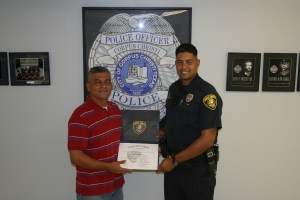
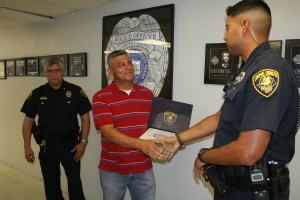
Corpus Christ Police Department Lieutenant Brian Hill is a 33-year veteran of the police force who, in 1996, saved the life of a dazed and incoherent motorist involved in a traffic accident by breaking out the rear window of his burning car and pulling the man to safety. Hill is currently a patrol shift supervisor whose experienced leadership has been instrumental in helping the police department reduce crime and improve the quality of life for his fellow police officers and their families.
“The welfare of my officers and their families comes first,” said Hill who received a safety award from the City of Corpus Christi for his supervision of his patrol shift and his efforts to ensure the safety of his patrol officers.
Assistant Chief Peter Peralta, a 31-year veteran with the sheriff’s office was chosen as a Hometown Hero for his courage and determination in overcoming the loss of his left leg below the knee on November 8, 2011 and his persistence in rehabilitation which resulted in him returning to full duty status four months later in March 2012.
Peralta, began his career as a Deputy Sheriff in April 1981 and rose through the ranks to his current post as Assistant Chief of Operations. Nueces County Sheriff Jim Kaelin said”, Chief Peralta’s return to duty can only be described as remarkable and a tribute to his personal courage.”
“He is a great credit to our office and a tremendous example for our other deputies,” Kaelin said.
During the breakfast, the Red Cross will also present awards to local people and businesses who became “Heroes” by either contributing or raising at least $1,000 to support disaster relief efforts in the Coastal Bend.
“Red Cross responds to more than 70,000 emergencies in the United States each year,” said chapter Executive Director Pete Wyro. “From July last year through June this year, Red Cross responded to 168 emergencies, providing food, clothing and shelter to more than 420 individuals while helping more than 400 additional people connect with other charities to help them begin the recovery process,” Wyro said. “There were at least 95 emergencies in Nueces County to which the Red Cross responded. These do not include the almost 7,000 members of the armed forces and their families who the Red Cross helped during times of family emergencies or the almost 12,000 people trained to perform CPR, provide first aid or use an Automated external defibrillator.”
“The Red Cross depends on donations to meet the needs of victims of emergency so the Heroes campaign is really a kick off for our year-round fundraising efforts,” Wyro said.
“You can donate to the Red Cross by sending a check to the American Red Cross at P.O. Box 3429 Corpus Christi, TX 78463 or you can donate online at www.cbtredcross.org,” Wyro said.

 CCPD Blotter
You must be logged in to post a comment.