Category Archives: Community Outreach

Fake Groupon Discount Offer Hides Virus

The Corpus Christi Police Financial Crimes Investigators would like to warn the public of a new email scam that infects computers with a virus.

The email that transmits a virus is presented as a shopping deal from Groupon complete with the colors, logo, and email format. The email has an attachment file called “group coupon.zip” which contains a virus designed to infect the Windows operating system.

Police advise the public to keep an updated virus software program and run a scan periodically. Anyone that questions the validity of any Groupon deal should contact the company’s customer support.

Visit the Better Business Bureau website for more information about breaking scams in our area.

Run, Hide, Fight. Surviving an Active Shooter Event

With all the tragic shootings that have taken place in public places around the country recently, CCPD wanted to provide our citizens some information about what to do in the unlikely event that they find themselves in a location where an active shooter is targeting people. The following video was produced by the city of Houston. We would like to thank the City of Houston’s Mayor’s Office for allowing us to share this link.

The video is a Department of Homeland Security Grant Funded Project, produced by the City of Houston’s Mayor’s Office of Public Safety and Homeland Security.  The City grants permission to use the video in the format provided for its intended purpose only, information and awareness training for the general population.

English

http://www.readyhoustontx.gov/runhidefightspanish.html (Spanish/Espanol)

Red Cross To Recognize Hometown Heroes Tuesday

Contributed by the Coastal Bend – South Texas Chapter of the Red Cross:

A Corpus Christi firefighter, police lieutenant and assistant chief for the Nueces County Sheriff’s office have been selected to receive Hometown Heroes awards at the Red Cross Heroes Breakfast Tuesday, August 14, 2012 at 8 a.m. at the Solomon P. Ortiz Center. Eddie Yaklin, who received national attention in 2009 for rescuing three fisherman who were stranded 185 miles offshore for eight days will be the featured speaker.

Corpus Christi fireman John Keller, Corpus Christi Police Lieutenant Brian Hill and Nueces County Sheriff’s Office Assistant Chief Peter Peralta were chosen as hometown heroes for their actions in overcoming seemingly overwhelming obstacles to serve their community and to save and preserve lives.

On March 30, 2012, Firefighter Keller, a native of Louisiana and former school teacher responded to a call for a person in distress in Corpus Christi Bay. There the four-year fire department veteran found a man clinging to his overturn and partially submerged pontoon boat 450 yards offshore. Ignoring his own safety, Keller dove into the wave and swam to the stranded man, placed a flotation device around him and pulled him to shore where other firefighters then took over.

A former lifeguard and avid bodysurfer, Keller credits beach lifeguards and an experience where he almost lost his mother to his desire to become a fireman.

            Corpus Christi Fire Chief Robert Rocha said Keller’s actions were “above and beyond the call of duty even considering the danger our firefighters face almost every day.”

Corpus Christ Police Department Lieutenant Brian Hill is a 33-year veteran of the police force who, in 1996, saved the life of a dazed and incoherent motorist involved in a traffic accident by breaking out the rear window of his burning car and pulling the man to safety. Hill is currently a patrol shift supervisor whose experienced leadership has been instrumental in helping the police department reduce crime and improve the quality of life for his fellow police officers and their families.

“The welfare of my officers and their families comes first,” said Hill who received a safety award from the City of Corpus Christi for his supervision of his patrol shift and his efforts to ensure the safety of his patrol officers.

Assistant Chief Peter Peralta, a 31-year veteran with the sheriff’s office was chosen as a Hometown Hero for his courage and determination in overcoming the loss of his left leg below the knee on November 8, 2011 and his persistence in rehabilitation which resulted in him returning to full duty status four months later in March 2012.

Peralta, began his career as a Deputy Sheriff in April 1981 and rose through the ranks to his current post as Assistant Chief of Operations. Nueces County Sheriff Jim Kaelin said”, Chief Peralta’s return to duty can only be described as remarkable and a tribute to his personal courage.”
“He is a great credit to our office and a tremendous example for our other deputies,” Kaelin said.

During the breakfast, the Red Cross will also present awards to local people and businesses who became “Heroes” by either contributing or raising at least $1,000 to support disaster relief efforts in the Coastal Bend.

“Red Cross responds to more than 70,000 emergencies in the United States each year,” said chapter Executive Director Pete Wyro. “From July last year through June this year, Red Cross responded to 168 emergencies, providing food, clothing and shelter to more than 420 individuals while helping more than 400 additional people connect with other charities to help them begin the recovery process,” Wyro said. “There were at least 95 emergencies in Nueces County to which the Red Cross responded. These do not include the almost 7,000 members of the armed forces and their families who the Red Cross helped during times of family emergencies or the almost 12,000 people trained to perform CPR, provide first aid or use an Automated external defibrillator.”

“The Red Cross depends on donations to meet the needs of victims of emergency so the Heroes campaign is really a kick off for our year-round fundraising efforts,” Wyro said.

“You can donate to the Red Cross by sending a check to the American Red Cross at P.O. Box 3429  Corpus Christi, TX 78463 or you can donate online at www.cbtredcross.org,” Wyro said.

Police Thank Citizen For Help

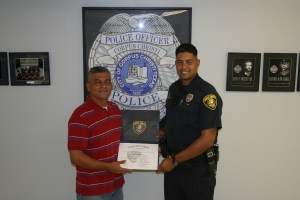
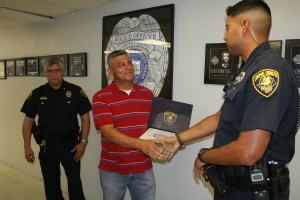
Victor Zamora accepted a Citizens Certificate of Merit from Patrol Officer Eric Garza

Occurred Wednesday, August 1, 2012, 19:23, Beach Marker 224, Assault, Resisting Arrest, Reckless Driving, 1208010119

A 54-year-old man was recognized Friday, August 10, for his action that helped a police officer in a struggle with four people on the beach on August 1.

The Corpus Christi Police Department held a ceremony at the Flour Bluff Police Assembly Point to honor and thank 54 year old Victor Zamora for his part to aid an officer. Mr. Zamora said he would gladly do anything to help a person in need.

Corpus Christi Police Officer Eric Garza was dispatched to the area of Beach Marker 224 at 7:23pm on August 1 for a reckless driver. Officer Garza saw a red 2000 Mitsubishi Montero sport utility vehicle doing donuts on the beach and initiated a traffic stop. The operator of the vehicle, 19-year-old Kyle Fisk (7/13/1993) displayed aggressive behavior toward Officer Garza. Officer Garza demanded Fisk exit the vehicle. Fisk exited the vehicle then fought with Officer Garza to prevent the application of handcuffs.

The three other occupants of the vehicle then got out of the vehicle and then interfered with the arrest while Officer Garza and Fisk fought in the sand.

Mr. Zamora saw the struggle and stopped to help Officer Garza.

Other Police Officers arrived and arrested: 18-year-old Christian Rodriguez (2/26/1994) for interfering with public duties; 19-year-old Caitlin Fisher (8/3/1992) for assault by contact and interfering with public duties; and 19-year-old Joseph Mitchell (12/25/1992) for interfering with public duties. Fisk was arrested for reckless driving and resisting arrest and the red Montero was impounded.

Assistant Chief of Police J.V. Garcia stands with Victor Zamora as Officer Eric Garza thanks Mr. Zamora for his actions

Police Officers Learn About Insurance Fraud

The National Insurance Crime Bureau provided training Friday to area law enforcement at the Del Mar College and hosted by the Corpus Christi Police Departments Auto Theft Task Force to provide information to identify fraudulently altered or stolen vehicles through document review and vehicle inspection.

According to the National Insurance Crime Bureau, insurance fraud costs 30 billion dollars per year which is passed onto the insurance customers. The objective for the day long class was to equip law enforcement officers with the ability to decode and detect fraudulent Vehicle Identification Numbers.

ThNational Insurance Crime Bureau is a not for profit organization formed in 1992 dedicated exclusively to fight insurance fraud and crime. The N.I.C.B. has membership of over 1,000 property and insurance companies, self insured organizations, rental car companies, parking service providers, and transportation-related firms. The N.I.C.B. provides training to law enforcement without fee. The class was taught by N.I.C.B. Agents John Mitchell and Mike Gallagher.

Law Enforcement Officers learned about the 17 character Vehicle Identification Number system. The V.I.N. is mandated by Federal regulations as the primary identification number for all vehicles made after 1981.

The N.I.C.B. has the goal to provide the training to the law enforcement officers today to prevent and combat insurance fraud and crime through data analytics, investigations, and public awareness.

As part of the public awareness campaign, the public may use the N.I.C.B.s  VINCheck program for no fee. The VINCheck program allows the public to determine if a vehicle has been reported stolen and not recovered or reported as salvaged. Visit the N.I.C.B. website https://www.nicb.org/theft_and_fraud_awareness/vincheck/vincheck for more information.

What to do if you are in a vehicle crash

What do I do if I am in a vehicle crash?

There are many crashes every day in Corpus Christi. Most are minor and have no injuries. It is important to know what to do if you are unfortunate to experience one of these crashes. Your reaction can prevent injuries, reduce the cost, and accelerate the cleanup.

Safety First:

Drivers involved in minor accidents with no serious injuries should move cars to the side of the road and out of the way of oncoming traffic. Additional accidents and injuries can result if cars are left parked in the middle of the road or busy intersection. Drivers and passengers should remain in the cars with seat belts fastened for everyone’s safety until help arrives if the car cannot be moved. Turn on hazard lights and set out cones, flares or warning triangles if it is safe and practical. Provide any aid to injured people if at all possible or appropriate.

Call Police:

The emergency services representative that answers the phone will ask if there are any injuries as a result of this crash. That is a priority for emergency services response. The representative will ask for the location of the crash, how many vehicles are involved, if traffic is blocked by crashed vehicles, and the description of the vehicles. Be ready to provide the information so there will be as little of a delay as possible by emergency responders.

Exchange Information:

Exchange the following information: name, address, phone number, insurance company, policy number, driver license number and license plate number for the driver and the owner of each vehicle. Establish what the relationship is and take down the name and address for each individual if the driver’s name is different from the name of the insured. Make a written description of each car, including year, make, model and color — and the exact location of the collision and how it happened. Finally, be polite and be patient.

Document the Crash:

Use your camera to document the damage to all the vehicles. Keep in mind that you want your photos to show the overall context of the crash. Get the contact information of any witnesses to the event. Have your driver’s license and proof of insurance ready for the police officer that responds. Crash reports also require the identifying information for all occupants of each vehicle involved in a crash. Have the passenger’s information like identification cards and seat positions ready for the police officer that reports the crash. Let the emergency responders know of any preference of a tow service needed as soon as practical; otherwise, the police officer will request a wrecker from a rotation list.

Auto accidents take a tremendous toll on everyone involved, both financially and emotionally. If you’re one of the lucky ones who have thus far avoided a serious accident, hopefully the tips on prevention will help keep it that way. The chances are high, though; that at some point you will be involved in a minor accident. Just keep your head and make safety your primary concern.

Move Over Public Service Announcement (click link for video)

When you see emergency workers on the side of the road, move over. If you can’t move over, slow down.

Deaths and injuries prompted Texas to enact the move over law in 2003.

When you see lights, when you see vests, slow down and move over.

Texas Transportation Code 545.157 defines the requirements of the Texas Move Over Act. It requires that drivers vacate the lane adjacent to a stopped, authorized emergency vehicle that has its emergency lights on, or slow down to 20 miles per hour below the posted speed limit when the posted speed limit is at or above 25 miles per hour (or slow to 5 mph when
the posted speed is less than 25 mph).

What to expect in traffic enforcement (click link)

What the public should do if police initiate a traffic stop:

1. When You See the Police Car

Pull over to the right safely and quickly if a police car is behind you with its emergency lights flashing. Use your turn signal to indicate any lane changes from left to right, and slow down fairly quickly, but not so quickly that the officer will have to brake to avoid hitting you. Pull over as far to the right as possible so that, when the officer comes up to your widow, he or she will worry less about passing traffic.

The best practice is to pull into a parking lot where there is no passing traffic. Once stopped, the best practice is to put the vehicle in park and turn on the interior light if it is dark. It is best to place both hands on the steering wheel so that the officer can see them. It is best to search for documents like proof of insurance and driver’s license after requested by the officer. Stay in the vehicle unless instructed to exit by the police officer.

What does the officer do while I wait?

The officer activates the emergency lights and notifies the dispatch personnel of the traffic stop. The officer provides the location of the stop, the license plate characters of the vehicle, and a description of the vehicle stopped. The officer requests the registration information from the car which is information if the vehicle has been reported stolen, the expiration date of the registration, the registered owner’s information, and the vehicle description.

The officer will approach your vehicle while looking for signs of anything that might indicate criminal activity or a threat to the officer or citizen safety. Criminals are located and arrested during simple traffic stops every day.

The officer will discuss the violation with you and request your driver’s license and proof of insurance. The officer will return to the patrol car to check the status of the license and to check for any warrants for arrest. The officer must document information as to the ethnicity and gender of the operator of the vehicle stopped, the reason for the stop, if an arrest was affected during the stop, if a search was conducted, and if a citation was issued. The officer must then complete any citation or warning before returning to your car. Please be patient, this may take a few minutes.

The officer will explain the citation and return your documents to you. The officer may ask you to sign a citation. Your signature only indicates that you received the citation, not that you agree with it. When the officer is finished with the traffic stop, he or she will tell you that you may go. You should carefully pull back out into traffic.

What if I have a gun in my car?

It is much safer for you and the officer if you tell the officer about the weapon immediately, then follow the officer’s directions. Don’t reach toward it.

What if I didn’t do it?

The time to argue about your guilt or innocence is in court. Instructions on how to plead guilty or not guilty are printed on the citation.

The Patrol Officers Day Starts With Roll Call

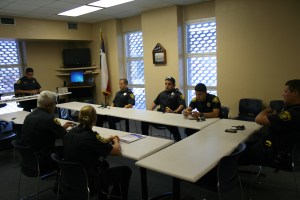
The Shift gathers for roll call

What is roll call?

The Corpus Christi Police Officers begin their work day in a classroom setting. The shift supervisor, a Lieutenant by grade, takes attendance and conducts uniform and equipment inspections. The Lieutenant then provides the group of 8-12 patrol officers with a briefing.

What is briefing?

There are several types of briefings which are: Information; Decision; Mission; and Staff. The briefing provided to the patrol officers at roll call is typically an information brief. Information briefs present primarily facts to the audience and does not seek decisions, it does not include recommendations, and it does not provide conclusions. The purpose of the briefing is to transfer high priority information to an audience that requires immediate attention. The briefing may explain complicated information to provide clarity and to remove confusion.

The information provided to the patrol officers is recent and significant. It may be information about weather conditions, recent crime trends, neighborhood problems that have surfaced, traffic obstructions like street closures, approaching crowded events, safety concerns, or a variety of other information.

Training opportunities also rise in the time for briefing. Lieutenants use the computer and technology to show videos from police events around the world which provide a venue of consideration for how the individual officers may respond to situations recorded on video. Many shifts listened to the police radio broadcasts of the Colorado theater massacre recently to have conversation about the most effective method for transmitting information over the radio in an active shooter situation.

The roll call usually takes 30 minutes and concludes with issuance of patrol car keys, beat assignments, and special instructions provided to the individual patrol officers. Officer Paddock and Officer Martinez are assigned to the beat known as D360.

Corpus Christi Police Host Virtual Ride-A-Long

The public will be able to do a virtual ride-a-long from the comfort of home Wednesday, August 8, 2012 with the Corpus Christi Police Department from 5:30pm until 12:30am.

The Corpus Christi Police Department will show the photographs and announce the activity on Twitter as it happens. Anyone interested to experience the virtual ride-a-long with the Corpus Christi Police can follow the activity on Twitter @CorpusChristiPD. The Twitter message will begin at 5:30pm when the shift roll call happens, then document the officer’s activity through the entire shift.

The purpose of the event is to provide the public an example of the work day for a typical Corpus Christi Police Patrol Officer. This is the first such event the Corpus Christi Police Department has hosted. Followers on Twitter will be able to ask questions as the virtual ride-a-long happens.

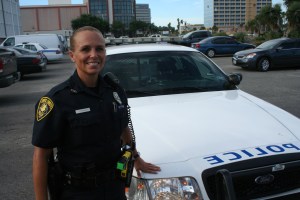
The virtual ride-a-long will be with Corpus Christi Police Officer Trenade Paddock and the officer she trains from the 70th Police Academy Class, Officer Phillip Martinez, as they patrol the Delta District Wednesday night.

Visit the Corpus Christi Police Department twitter account and “follow” CorpusChristiPD to experience and participate in the first virtual ride-a-long with the Corpus Christi Police Department.

Officer Paddock is a single mother of 5 children that joined the Corpus Christi Police Department in 2009. Officer Paddock is currently enrolled at Texas A&M to complete her Master’s Degree in Counseling by next summer. Officer Paddock grew up in Bedford, Indiana and joined the Navy directly out of High School. Officer Paddock taught Physical Education in California for 8 years before returning to Indiana for 3 years to work in a hospital as a medical assistant. Officer Paddock moved to Corpus Christi 5 years ago and worked 2 years as part of Project Turnaround for the Coastal Bend AIDS Foundation. Officer Paddock was selected to serve on the Corpus Christi Police Honor Guard and is now assigned as a Field Training Officer for the 70th Police Academy Session.